By Parabilis,
the leader in Federal Market Credit (FMC)
For small federal contractors, the most important date on the calendar is December 11, 2026, when the stopgap law funding every federal agency expires.
Democrats won control of both the House and the Senate on November 3 and will take over when the new Congress is sworn in on January 3, 2027. Until then, Republicans still run both chambers, and the outgoing Congress has to finish fiscal year 2027 funding, the annual defense authorization bill, and a stack of expiring programs before it adjourns. The result changes the incentives behind those deals, and it will shape how much uncertainty small firms carry into the new year.
So let’s explore where things stand after the election, what the change in control could mean for contracting, the policy changes already in motion regardless of the result, and a practical playbook for the lame-duck period.
Where things stand after the election
Democrats flipped the Senate and won a House majority, ending unified Republican control of Congress. As of November 5, Democrats were on track for at least 54 Senate seats, counting the two independents who caucus with them, with a few races, including Mississippi and Alaska, still uncalled. President Trump keeps the veto, so starting in January contractors will operate under divided government: a Democratic Congress and a Republican White House.
Leadership is shifting, too. House Republicans vote on November 10 to choose a new leader after Speaker Mike Johnson said he would not seek the post, and that choice determines who negotiates the funding bill with Democrats during the lame duck. House Democratic Leader Hakeem Jeffries has announced his candidacy for speaker in the new Congress.
Regarding funding, the government is running on autopilot under a stopgap law that expires December 11, 2026. The Department of Homeland Security is in an especially unsettled position: it still lacks a full-year appropriation, and its lapse earlier in 2026 was the longest in the department’s history.
The defense side is also unfinished. The FY2027 National Defense Authorization Act (NDAA) stalled in the Senate in July, and House and Senate negotiators are working from the Senate Armed Services bill (S. 4784) and the House bill. Spending tied to the conflict with Iran adds another variable, with some senators floating an omnibus with emergency Pentagon money plus a separate reconciliation package. Defense is now the sharpest point of disagreement: the administration is asking for a record $1.5 trillion in military spending, a figure Senate Democrats reject, and about $350 billion of it could be attempted through a third reconciliation bill.
Inside the December 11 stopgap
The current stopgap keeps every agency open for 72 days at roughly FY2026 levels, but it restricts how agencies can spend, and those restrictions land hardest on contractors waiting for new work.
The basics. The Continuing Appropriations and Extensions Act, 2027 (H.R. 6500, P.L. 119-103) was signed September 2, 2026, after passing the Senate 90-6 and the House 370-48. Division A is the stopgap itself, covering all 12 appropriations bills from October 1 through December 11, roughly the first 10 weeks of FY2027. CBO estimates it provides $1.701 trillion in annualized discretionary budget authority. Divisions B through D extend other expiring authorities, including surface transportation programs and VA authorities. When it passed, none of the 12 regular FY2027 bills had been enacted: the House Appropriations Committee had reported all 12 and the House had passed three, while the Senate Appropriations Committee had reported none.
How the money flows. Agencies may spend at a rate based on their FY2026 appropriations. OMB generally apportions a pro rata share, so for a 72-day stopgap agencies get access to about one-fifth of a full year’s funding. Anything spent now counts against whatever full-year amount Congress eventually enacts, not on top of it.
What agencies cannot do. Several provisions are designed to preserve Congress’s final funding decisions, and they directly affect the contract pipeline:
- No new starts (Sec. 104): agencies cannot begin programs, projects, or activities that were not funded in FY2026.
- No front-loading (Sec. 109): agencies cannot obligate funds for programs with high early spending rates or award grants that would preempt final funding decisions.
- Minimum necessary spending (Sec. 110): agencies must take only the most limited funding action needed to continue existing work. In practice, this means incremental funding and shorter periods of performance.
- Defense limits (Sec. 102): DoD cannot fund new production, increase production rates above FY2026 levels, or start multiyear procurements that use advance economic order quantity funding.
Exceptions that matter to contractors. The law also includes “anomalies,” exceptions to the general rules for specific programs. Those most relevant to the contracting community include:
| Section | Agency | What it allows |
| 126 | Navy | Funding for prior-year shipbuilding cost increases on specified programs |
| 127 | DoD | Up to $2.85 billion in Procurement, Defense-Wide for National Security Systems, which can reach many contract line items |
| 130 | NNSA | Funding to prevent project demobilization at the Nevada National Security Site and the termination of a Los Alamos transmission line contract |
| 131 | DOE | Continued work on the Waste Isolation Pilot Plant hoisting project |
| 120 | Census Bureau | Funding to keep 2030 Census systems build-out and testing on schedule |
| 121 | NOAA | Funding to hold launch schedules for the GeoXO satellite program |
| 101(8) | IRS | Access to previously restricted balances, which the administration said was needed for IT modernization |
| 146 | DoD | A new-start exception for dormitory construction at the Medical Education Training Complex in San Antonio |
| 150, 151 | FHWA, FAA | Reappropriated prior-year highway infrastructure and FAA research funds, available through FY2027 |
| 133 | SBA | 7(a), 504 and SBIC lending at the rate needed to meet demand |
| 137 | FEMA | Up to $26.37 billion for the Disaster Relief Fund if carryover balances run out |
| 157 | OMB | Blocks a proposed Uniform Guidance rewrite for federal grants through December 11 |
Homeland Security runs on its FY2026 law (P.L. 119-86) as the baseline. Border Patrol and ICE operate separately on multiyear funding from the FY2026 reconciliation law (P.L. 119-98), which is why DHS contract spending kept climbing despite the stopgap.
What happens December 12. If Congress passes neither full-year bills nor another stopgap by December 11, a funding gap begins, and agencies must shut down most affected activities. Certain mandatory payments funded through these bills can continue into early January. Contracts already fully funded with prior-year money can generally continue, while work that depends on new FY2027 obligations is at risk of stop-work orders.
Financial implications for the federal marketplace
The federal market is getting bigger, but the money is flowing to fewer companies and a narrower set of missions. That combination, more than any single election result, is the financial backdrop small contractors carry into the lame duck.
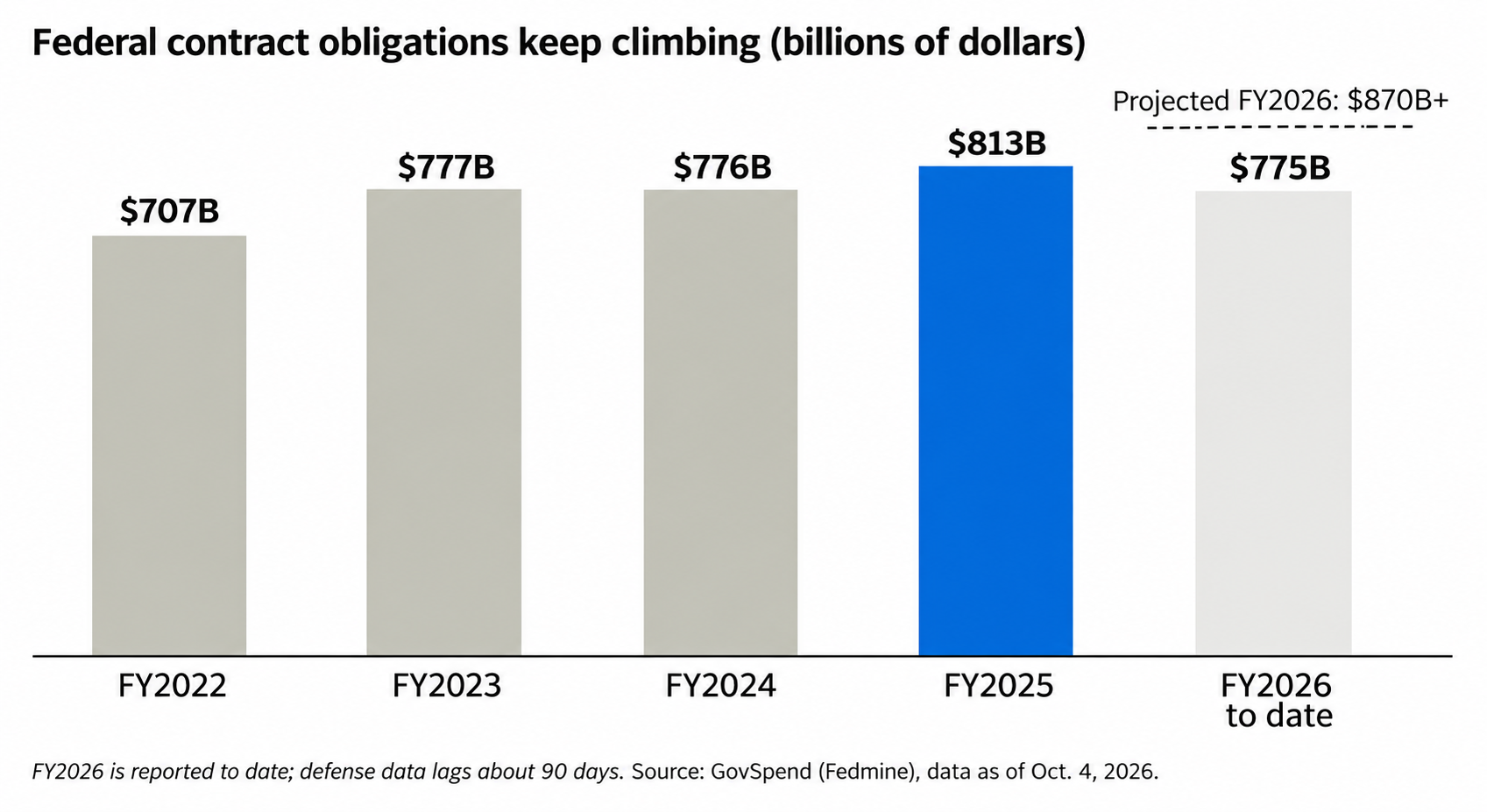
GovSpend (Fedmine) analysis of federal contract obligations, data as of October 4, 2026
The pie is growing. GovSpend expects FY2026 obligations to pass $870 billion once delayed defense data is reported, and Bloomberg Government projects total contract outlays topped $1 trillion for the first time, driven by national security and immigration enforcement.
But it is shifting between agencies. Non-defense obligations jumped to about $372 billion in FY2026, up roughly $69 billion from FY2025, the largest increase in a decade. Nearly two-thirds of that gain came from the Department of Homeland Security, which went from $28.4 billion to $73.5 billion, led by Customs and Border Protection, the Coast Guard, and ICE. The FAA’s air traffic control modernization pushed Transportation up about 50%. Meanwhile, USAID contracting fell from $4.2 billion to $1.0 billion, EPA and Treasury declined, and FEMA’s procurement dropped 92% in the first three quarters of the year. A firm’s outlook depends far more on which agencies it serves than on the overall total.
And fewer companies are sharing it. GovSpend counts 93,322 companies receiving awards in FY2026 so far, against 105,182 in FY2025. Among non-defense agencies alone, about 4,000 fewer firms won work even as spending rose 22%. Some of that gap will close as defense data arrives, but it is consistent with consolidation, category management and best-in-class vehicles concentrating dollars among incumbents.
Small business share is holding, with pressure underneath. SBA’s FY2025 scorecard shows agencies awarded nearly 28% of prime dollars, about $179 billion, to small businesses, beating the 23% goal for a third year. That was down in dollars from FY2024, and the small disadvantaged business share slipped from 12.27% to 11.6% amid 8(a) scrutiny. Women-owned (about 4.2%) and HUBZone (about 2.6%) firms again missed their goals. Early FY2026 data shows small business awards at 20.5% of reported spending, a number that typically rises as defense data is added, with set-asides at just 6.6% of awards.
Funding gaps carry a real price. The U.S. Chamber of Commerce counted at least 65,500 small business contractors who received over $155 billion in federal payments in a year, and estimated about $3 billion a week in contractor revenue at risk during the 2025 shutdown. Unlike furloughed federal employees, contractors have no guarantee of back pay. Even without a lapse, a CR pushes new awards to later in the fiscal year, which compresses competitions, delays revenue recognition and strains working capital.
The financial takeaway for the lame duck: a full-year omnibus would release growth money in DHS, Transportation and defense quickly, while a long CR freezes agencies at FY2026 levels and delays new starts. Firms aligned with the growth agencies have the most to gain from a December deal; firms tied to shrinking agencies face pressure either way.
What the result means for contractors
The election changes incentives in the lame duck more than it changes the rules contractors operate under today. With control of both chambers changing hands, the outgoing Republican majorities have the strongest reason to lock in full-year funding, defense money, and possibly a debt-limit increase before January, while incoming Democrats have less reason to settle spending now. There is recent precedent for a stalemate: after Democrats won the House in 2018, the outgoing Congress failed to agree on funding, and a 35-day shutdown began December 22 and ran into the new Congress.
| Area | Lame duck (through January 3) | New Congress (from January 3) |
| Funding | Republican majorities choose between an omnibus, another short CR, or a lapse; Democrats have less reason to deal now | Democrats control both appropriations committees and are likely to use them to protect programs the administration has proposed cutting; higher shutdown risk in future budget fights |
| Defense | Push to lock in defense spending, possibly through reconciliation, before Democrats take over | New Armed Services leadership expected to scrutinize defense spending growth, funding allocations, and contract awards |
| Oversight and small business programs | Confirmations and must-pass bills crowd the calendar; little room for new small business legislation | Hearings likely on immigration enforcement contracting, 8(a), and set-aside changes; major new laws still need 60 Senate votes and face a presidential veto |
Two points hold regardless of the shift in power. First, the administration keeps control of procurement regulations, so changes moving through the FAR Council and SBA continue regardless of the vote. Second, divided government historically means more stopgap funding and more shutdown brinkmanship, which hits small firms hardest because they have the thinnest cash reserves.
Supporters of the current approach argue that streamlined rules, higher thresholds, and consolidated buying reduce cost and paperwork, including for small firms. Critics, including many small business advocates, argue that discretionary set-asides on task orders and category management concentrate work among fewer, larger vendors. Congressional oversight in 2027 is likely to revolve around that disagreement.
Policy changes already in motion
Several changes affecting small contractors are moving forward regardless of the shift in congressional control.
The FAR overhaul. The Revolutionary FAR Overhaul, ordered by Executive Order 14275 in April 2025, is now in formal rulemaking. Eight proposed rules have been published, and comments on the September batch closed October 19; four more proposed rules and all final rules are still to come. Part 19, which governs small business programs, has not yet appeared in any proposed rule, though agencies are already operating under class deviations. Under those deviations, the Rule of Two survives for new contracts, but contracting officers no longer must prioritize socioeconomic set-asides over general small business set-asides, and set-asides on task and delivery orders under multiple-award contracts are discretionary and not protestable.
Higher thresholds. The micro-purchase threshold rose from $10,000 to $15,000 in October 2025, and the threshold for certified cost or pricing data rose from $2.5 million to $10 million on June 30, 2026. Both reduce paperwork, but more buys at the low end also means more competition for quick, informal awards.
8(a) changes. SBA’s final rule of August 11, 2026, effective September 10, removes the rebuttable presumption of social disadvantage for individually owned firms and replaces it with an evidence-based test. Current participants do not have to requalify, and entity-owned firms (tribal, ANC, NHO and CDC) are not affected. This follows a program-wide SBA audit that led to suspensions of roughly a quarter of 8(a) participants for failing to submit records. The incoming Democratic majorities could hold hearings on these changes, but reversing them would require legislation the president signs or a future administration.
The FY2027 NDAA. Provisions to watch in conference include a Senate proposal for a $50 million grant program covering up to $100,000 of a small firm’s CMMC Level 2 assessment costs; extensions to the DoD Mentor-Protégé Program, APEX Accelerator funding, and the comprehensive subcontracting plan test program; and Senate Section 815, which would bar DoD contractors from stock buybacks and dividends with no exemption for small businesses. Industry observers expect Section 815 to be dropped or sharply narrowed, but closely held firms that pay owner distributions should track it.
CMMC. Cybersecurity certification requirements are already in DoD contracts. A grant would help with cost, but it only matters if it is both authorized and funded, so readiness work should not wait on Congress.
What to expect during the lame duck
Congress returns November 9 for a session expected to run until Christmas, with a Thanksgiving break in between. That leaves roughly five working weeks for a very full agenda.
The key dates:
- November 3: Election Day. Democrats won control of both chambers, effective January 3; a few races are still being counted.
- November 9: Both chambers return.
- November 10: House Republicans choose a new leader, who will negotiate the funding bill with Democrats.
- Late November: Thanksgiving recess.
- December 11: The current CR expires. Congress must pass full-year bills, an omnibus, or another CR to avoid a shutdown on December 12.
- December 31: A second wave of deadlines, including healthcare extenders, TANF and the Export-Import Bank’s charter.
- January 3, 2027: The new Congress is sworn in. Anything unfinished starts over or rolls into the agenda of the new Democratic majorities.
There are three realistic paths for FY2027 funding. An omnibus or package of full-year bills would give agencies certainty and let new contract starts move. A short CR into early 2027 would hand the decisions to the new Congress, keeping agencies on prior-year levels and generally barring new programs. A funding lapse would occur if neither passes by December 11. With control changing hands in January, Republicans have the most reason to finish a full-year deal now, while Democrats have less incentive to settle spending before they take over.
The NDAA has passed every year for more than six decades, so it will very likely be enacted, though possibly late in December. The bigger open questions are the topline, Iran-related spending, and whether contentious items like Section 815 survive.
Small contractors should be clear-eyed about what a CR means in practice. Agencies under a CR typically avoid new starts, delay option exercises that require increased funding, and award incrementally funded work. Fourth-quarter-of-the-calendar-year awards often slip into January or later. And in a lapse, contractors working on unfunded contracts may receive stop-work orders, with no guarantee of recovering lost revenue. The 2025 shutdown, which began October 1 and became the longest in U.S. history, left small contractors with delayed payments and some canceled projects. Together with the long DHS lapse earlier this year, it is a recent reminder that these risks are real.
A practical playbook for small contractors
The goal between now and January is to protect cash, keep the pipeline realistic, and be ready to move fast once funding is settled.
- Stress-test cash flow. Model a scenario where the CR is extended into February and another where funding lapses for 30 days. Know how many weeks of payroll you can cover and line up a credit facility now, not in December.
- Sort your contracts by funding status. Identify which contracts are fully funded, incrementally funded, or due for option exercises before March. Incrementally funded and option-dependent work is most exposed.
- Talk to your contracting officers. Ask which pending awards and options they expect to move under a CR. Get any stop-work or slow-down direction in writing.
- Re-date your pipeline. Push expected award dates for new starts into Q2 FY2027 unless the agency has full-year funding or the work is a continuation.
- Document everything if a lapse happens. Track idle labor, demobilization and remobilization costs carefully. They may support a request for equitable adjustment later, but recovery is not guaranteed.
- Watch the NDAA conference text. Check final language on CMMC grants, mentor-protégé, Section 815 and subcontracting plans as soon as it is released.
- Adapt to discretionary set-asides. With task-order set-asides now discretionary, invest in relationships with small business specialists and target agencies that still use them often.
- 8(a) firms: check your status. Confirm your annual review and records are current. If you plan to apply, prepare evidence under the new social disadvantage test.
- Keep compliance moving. Do not pause CMMC readiness or FAR overhaul training waiting for Congress.
- Prepare for more oversight. If you work on DHS, immigration enforcement or fast-growing defense programs, as a prime or a sub, expect closer congressional scrutiny of those contracts in 2027 and keep your documentation clean.
- Engage your delegation. The lame duck and the start of a new Congress are when small business priorities get attached to must-pass bills. Trade associations and APEX Accelerators can help.
Bottom line
The election settled who will run Congress in 2027, but the December 11 funding deadline will decide how small contractors start the year. Plan for an extended CR as the base case, keep enough liquidity to ride out a short lapse, expect more oversight of contract spending under divided government, and treat the FAR overhaul and 8(a) changes as permanent features of the landscape until Congress or the courts say otherwise.
This article reflects publicly available information as of November 6, 2026, and is not legal or financial advice. A few races were still being counted, and legislative timelines may change quickly during the lame duck.
Sources
- CRS R49353: Overview of Continuing Appropriations for FY2027 (full report)
- CRS R49353 on Congress.gov
- Legis1: DHS funding unresolved
- Holland & Knight: Converging year-end deadlines
- No Labels: The 2026 lame-duck session
- Harbinger Strategies: Lame Duck Preview
- The Hill: Lame-duck agenda balloons
- FedCon: FAR overhaul status
- PilieroMazza: FAR Part 19 rewrite
- Holland & Knight: SBA 8(a) final rule
- Mayer Brown: Senate NDAA Section 815
- GovConFeed: CMMC Level 2 grant program
Financial data:
- GovSpend: Federal contract spending in FY26
- Bloomberg Government: Contract spending to top $1 trillion
- Bloomberg Government: FEMA contract spending down
- Legis1: FY2025 small business scorecard
- Federal News Network: $179B to small firms in 2025
- U.S. Chamber: Small business contracts letter to Congress
- PYMNTS: Shutdown costs contractors $3 billion a week
- AP via NY1: Small businesses await shutdown’s end
Post-election coverage:
- Edelman: What the 2026 midterm results mean for business
- CBS News: Democrats win Senate majority
- HNGN: Lame-duck Congress returns with funding deadline
- Washington Technology: What the midterm results mean for federal tech policy
- Morrison Foerster: What a Democratic Congress means for oversight in 2027
- ASA: A Democratic Congress and a Republican White House
- WilmerHale: Lame duck, high stakes
How Parabilis helps
Parabilis provides Federal Market Credit (FMC), a revolving line of credit built for small to mid-sized federal contractors. FMC lets you borrow against billed invoices, unbilled invoices, and delivery orders, so your working capital grows with your contract backlog. Learn more about our line of credit or contact our team to talk through your growth plans.
Parabilis, financing the future of federal contracting.